Copyright © 2024 Qingdao Pristine Steel Structures and Engineering Co.Ltd All Rights Reserved.  Powered by Hicheng

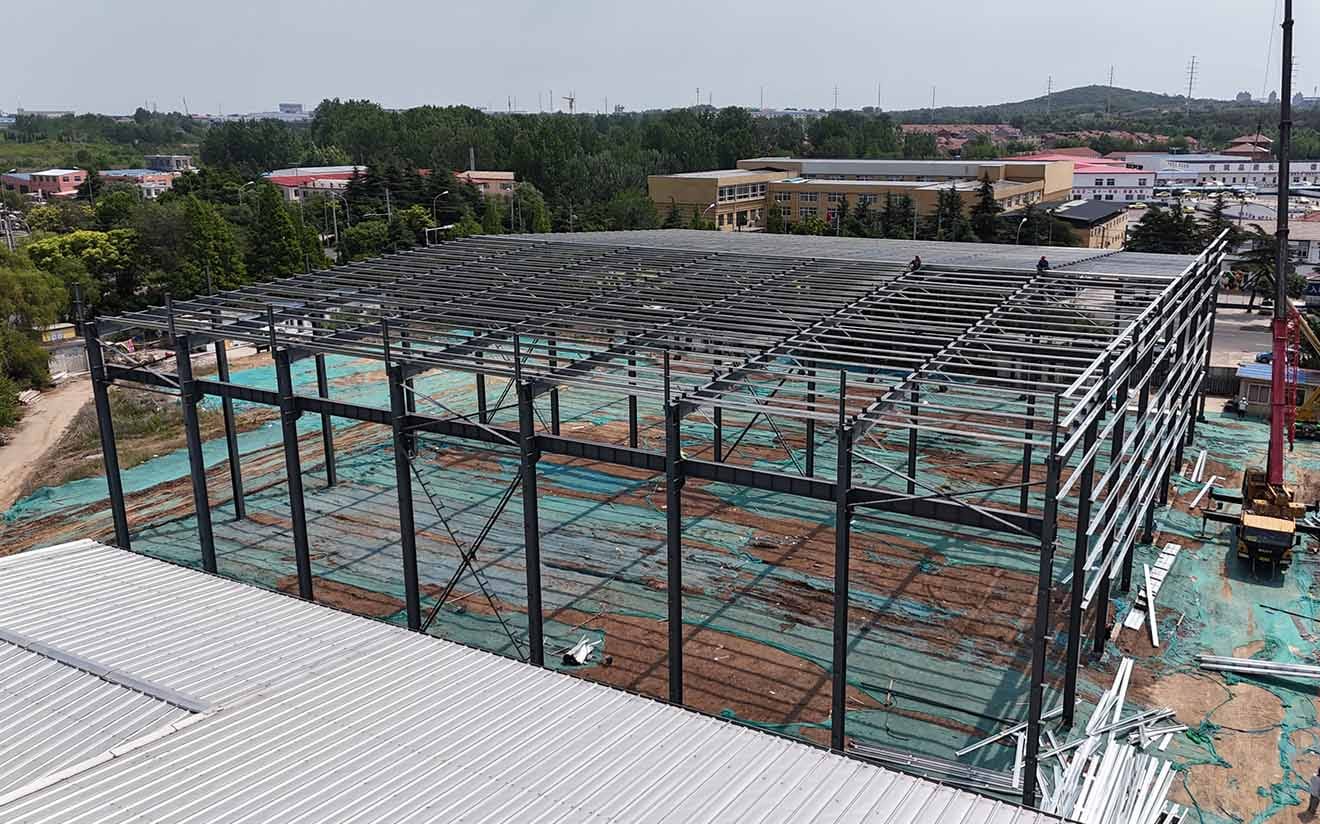
Small portal frame steel structure factory building (referred to as "portal steel") is the most common structural type in modern industrial workshops. It features remarkable advantages such as large span, light self-weight, fast construction, cost-effectiveness and flexible layout. Below we systematically sort out the entire fabrication and installation process from the aspects of key design points, fabrication procedures, installation steps, quality control , precautionary measures. The key points involved are as follows.
Key Design Points (Prerequisite for Fabrication & Installation)
1.Structure Selection
Determine the span, column spacing, eave height, crane availability and tonnage, mezzanine arrangement and other parameters according to production process requirements.
2.Load Calculation
Take into account dead loads (structural self-weight, roof and wall system), live loads (snow load, maintenance load), wind load (particularly critical for wind-resistant column design) , crane load and seismic action.
3.Key Joint Design
Beam-to-column joint: Generally connected with high-strength bolts via vertically placed end plates. As the lifeline of the portal frame, it must meet strict stiffness and strength requirements.
Ridge joint: Splice joint of two inclined beams, bearing relatively large bending moment.
Column base joint: Divided into hinged connection (usually for crane-free or small-tonnage crane buildings) and rigid connection (for crane-equipped or large-span buildings), with different requirements for foundation works.
4.Member Section Selection
Main frame columns and beams are mostly made of welded H-section steel or tapered H-section steel. Purlins and wall beams commonly adopt cold-formed thin-walled C-section or Z-section steel.
Qingdao Pristine Steel Structures and Engineering Co., Ltd.
Copyright © 2024 Qingdao Pristine Steel Structures and Engineering Co.Ltd All Rights Reserved.
Powered by Hicheng
