Copyright © 2024 Qingdao Pristine Steel Structures and Engineering Co.Ltd All Rights Reserved.  Powered by Hicheng

Steel Structure Factory Fabrication Process: Ensure Smooth On-site Installation via Precision Control
In the field of steel structure engineering, factory fabrication is the core link to ensure project quality and construction efficiency. This directly determines the safety, smoothness of on-site installation and the overall project quality. This article will detail the entire process of steel structure factory fabrication, focus on the core of precision control, take you to fully understand the standardized production system of professional steel structure components, and help you clearly grasp the key points of fabrication.
Core Principle: Precision control runs through the entire process to achieve on-site installation with zero delay
The core requirement of steel structure fabrication is full-process precision control. From the arrival of raw materials to the delivery of components, every process is aimed at "eliminating dimensional deviations and ensuring connection adaptability". Ensure uniform component dimensions and precise interfaces, and completely eliminate on-site secondary modifications. Realize that components can be installed immediately upon arrival, ensuring the efficient progress of the construction period.
7 Key Processes of Steel Structure Factory Fabrication (Professional Detailed Explanation)
1. Detailed Shop Drawing Design: The Preparatory Core of Precision Control
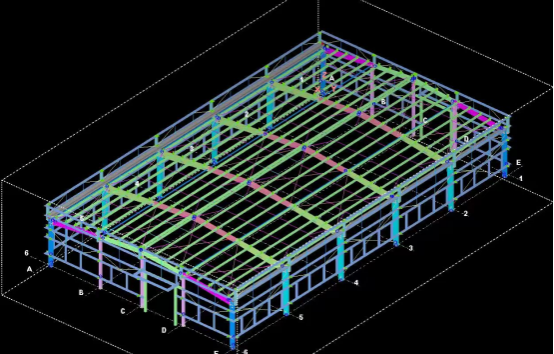
Based on the construction drawings provided by the design institute, mainstream industry detailed design software such as Tekla and XSteel are adopted to complete the component fabrication shop drawings, part cutting layout drawings, bolt hole layout drawings and node detailed design. During the detailed design process, senior structural designers conduct full-process control to optimize node structures and avoid fabrication and installation hazards. Ensure that the detailed drawings are highly consistent with the design intent, while taking into account the feasibility of fabrication and on-site installation requirements, laying a precise foundation for subsequent processes.
2.Raw Material Procurement and Inspection: Build a Solid Quality Foundation from the Source
The quality of raw materials directly determines the load-bearing capacity and durability of steel structures. We adhere to the principle of "strict selection and strict inspection" throughout the process, and all materials comply with relevant national and industry standards:
Steel: We mainly adopt Q235B and Q355B low-carbon structural steel. When entering the site, complete material certificates and inspection reports must be provided to ensure traceability of materials. Unqualified steel shall never be put into production.
Supporting Materials: Supporting materials such as high-strength bolts, ordinary bolts, welding electrodes, welding wires, and anti-corrosion paint must meet design specifications and industry standards. Before entering the site, product certificates and performance test reports must be verified to ensure they match the project requirements.
On-site Re-inspection: All incoming materials must undergo sampling re-inspection in accordance with specifications. Key indicators such as the mechanical properties and chemical composition of steel, the torque coefficient of bolts, and the anti-slip coefficient must be tested to eliminate quality hazards from the source.
3.Blanking and Cutting: Precisely Control Basic Component Dimensions
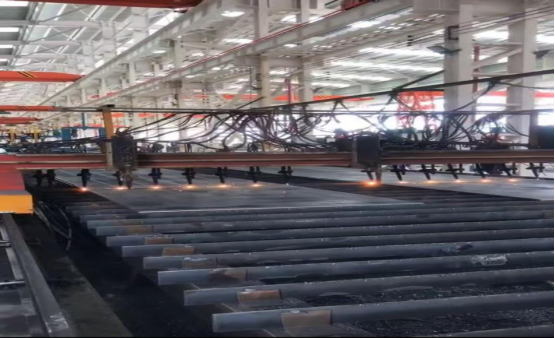
Blanking and cutting is the first critical procedure to guarantee component precision. We adopt intelligent high-precision equipment together with standardized working procedures to achieve efficient and accurate cutting while reducing material waste:
Plate cutting: CNC multi-head flame cutters and plasma cutters are applied, with cutting precision controlled within ±1mm. Suitable for processing large-area and multi-specification steel plates, the cutting surface is smooth and burr-free without secondary grinding.
Profile cutting: For H-beams, I-beams and other profiles, CNC band saws and special section steel cutting machines are used to ensure accurate cutting angles and dimensions, with the verticality and flatness of cutting surfaces meeting specification requirements.
Groove machining: Plate edges at welding positions shall be grooved in accordance with design requirements by edge planers and CNC groove cutting machines. It ensures accurate groove angle and root face size, guarantees welding quality and avoids welding defects
4.Assembly and Welding: Core Procedure with Strict Structural Strength ControlAssembly and welding are the core procedures of steel structure fabrication, directly affecting the load-bearing capacity and structural safety of components. Standardized operations are implemented throughout the whole process to strictly control welding quality and component precision:
H-beam Assembly: Positioning and clamping of flange plates and web plates are completed on a CNC H-beam assembly machine and fixed by spot welding. The positioning precision is controlled within ±0.5mm, ensuring vertical and close fitting between flanges and webs without misalignment or excessive gaps.
Welding Operation: Main welds are welded by gantry automatic submerged arc welding machines with intelligently controlled welding parameters throughout the process. The welds feature uniform formation with no slag inclusion, porosity, incomplete penetration or other defects, meeting Grade II or higher welding standards. For tapered beams and complex joints, dedicated welding procedures and fixtures are adopted to ensure smooth section transition and qualified welding precision.
Deformation Straightening: Welded components are prone to welding deformation. CNC H-beam straighteners and flange straighteners are used for precise correction. Combining thermal straightening and cold straightening methods ensures the straightness and verticality of components comply with specification requirements and fit perfectly for on-site installation.

5. End Milling and Drilling: Precisely Control Connection Accuracy
The reliability of steel structure connection depends on precise end machining and bolt hole position control. This procedure adopts high-precision professional equipment to ensure tight fitting and consistent hole alignment at all connecting parts:
End Milling: The end connection surfaces of beams and columns are processed by CNC end milling machines. The flatness tolerance after milling is ≤ 0.3mm/m, which ensures close contact of high-strength bolt friction surfaces, guarantees shear and tensile performance of joints, and avoids connection risks caused by uneven end faces.
Bolt Drilling: Bolt hole groups are machined by 3D CNC drilling machines and radial drilling machines, with hole position accuracy controlled within ±0.2mm. All connecting plate holes at the same joint are perfectly aligned without dislocation or deviation. No on-site hole reaming is required, enabling precise assembly directly and improving installation efficiency.
6.Surface Treatment and Coating of Components: Improve Durability and Service Life
The durability of steel structures mainly depends on surface anti-corrosion treatment. In strict accordance with GB/T 50205-2020 Standard for Acceptance of Construction Quality of Steel Structure Engineering, standardized surface treatment and coating processes are adopted to comprehensively improve the anti-corrosion performance of components.
Shot Blasting & Rust Removal: Components are sent to a CNC shot blasting machine. High-strength steel shots impact the surface to thoroughly remove rust, scale, oil and other contaminants. The blasting grade reaches Sa2.5, with surface roughness controlled at 40–70μm, enhancing coating adhesion and laying a solid foundation for anti-corrosion painting .
Anti-corrosion Coating: Primer painting shall be completed within 2 hours after blasting, with zinc-rich epoxy primer as the preferred option. The coating thickness is kept uniform without missing areas or sagging. The topcoat is selected according to design requirements and service environment, which can be pre-coated in the factory or fully painted after on-site installation. This avoids coating damage during transportation and installation, ensuring long-term anti-corrosion performance of steel structures.

7.Pre-assembly and Delivery: The Final Line of Precision Inspection
To ensure zero errors in on-site installation, components shall undergo strict pre-assembly and inspection before delivery, preventing any potential problems from being delivered to the construction site.
Pre-assembly Work: For complex joints, special-shaped components and the first batch of fabricated parts, 1:1 full-scale pre-assembly is carried out on the factory floor according to actual on-site installation conditions. The connection compatibility and dimensional deviations are checked and adjusted timely to guarantee smooth on-site installation.
Marking and Delivery: Each component is clearly marked with part number, center of gravity and installation direction, and properly packed with professional packaging materials to avoid collision and coating damage during transportation. Complete product certificates and inspection reports are issued before delivery, and components are delivered to the construction site on schedule to ensure construction progress.
Choose Our Steel Structure Fabrication Service — Outstanding Core Advantages
We have years of experience in steel structure factory fabrication. Centering on precision control, we integrate CNC processing equipment, professional technical teams and standardized operation systems, providing one-stop services covering shop drawing detailing, raw material procurement, production and processing, as well as component delivery.
All components are manufactured in strict accordance with industry standards with qualified precision and reliable quality, widely applied in various steel structure projects such as portal frame workshops, industrial plants, commercial buildings and bridges.
We can provide customized fabrication solutions according to project requirements. We control production quality throughout the whole process and strictly manage delivery schedules. Our professional team provides full-cycle communication to promptly solve all your questions during fabrication and installation. We deliver high-quality, high-efficiency and cost-effective steel structure fabrication support to help your project land smoothly.
Qingdao Pristine Steel Structures and Engineering Co., Ltd.
Copyright © 2024 Qingdao Pristine Steel Structures and Engineering Co.Ltd All Rights Reserved.
Powered by Hicheng
