
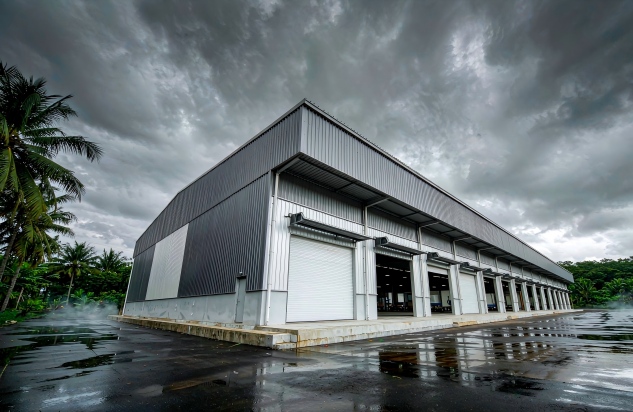
A prefabricated steel logistics warehouse in a tropical setting — designed for humidity, monsoon rain and local code compliance.
Southeast Asia is building warehouses faster than almost any other region. Industry research puts the region's warehousing market at roughly US$82 billion in 2026, growing at more than 12% a year, with Indonesia, Vietnam and Thailand the fastest-growing national markets at around 14–15% annually. E-commerce accounts for an estimated 38% of warehouse demand, and cold-chain facilities are expanding at more than 20% a year. Behind every one of those statistics is a practical question for anyone planning a logistics facility: what does a steel structure warehouse in this climate actually need to survive — and what codes does it have to satisfy?
This guide answers both. It covers the three climate factors that drive most specification decisions in the region — humidity-driven corrosion, monsoon rainfall, and heat with condensation — then walks through the building codes of the six major markets, and finishes with the structural numbers, procurement checklist and common mistakes that matter for Southeast Asian logistics projects.
Key takeaways
Coastal Southeast Asia is a C4–C5 corrosion environment under ISO 12944 — tropical coastal sites can exceed 5,000 hours of "time of wetness" per year, several times the exposure of inland Europe.
Coating specs must be in writing: Sa 2.5 surface preparation, three-coat systems of ≥200 µm DFT for C4 sites, Z275–Z350 galvanized purlins, and aluzinc (AZ150) or PVDF cladding near the sea.
Codes differ by country: NSCP 2015 (Philippines), SNI 1726/1727 (Indonesia), TCVN (Vietnam), MS EN 1993 (Malaysia), EIT (Thailand). Wind governs in the typhoon belt; seismic governs in Indonesia and much of the Philippines.
Structural drawings almost always need a locally licensed engineer's seal — a supplier's calculation package supports the permit, but does not usually replace it.
Budget benchmarks: published Malaysia project data indicates US$55–85/m² for a basic shell, US$80–130/m² for a standard insulated warehouse, and US$130–200+/m² for high-spec facilities.
In this guide
1. Why Southeast Asia, why steel
The demand side is well documented. Industry research estimates the region's warehousing and logistics market at roughly US$82 billion in 2026 with about 12% annual growth, and e-commerce gross merchandise value across Indonesia (about US$62 billion), Vietnam (US$22 billion, growing fastest at 35% a year), Thailand and the Philippines continues to pull distribution-center investment inland from the ports. Same-day delivery expectations in Jakarta, Ho Chi Minh City, Bangkok and Manila are pushing operators toward modern high-spec facilities — and away from the aging single-skin sheds that dominate much of the existing stock.
Steel frame structures fit this buildout for three practical reasons. First, speed: fabrication runs in parallel with foundation works, and a 3,000–5,000 m² building can move from order to weather-tight in three to four months. Second, span: column-free interiors of 30–50 m suit modern racking, mezzanines and automation without intermediate columns stealing floor area. Third, weight: steel frames are substantially lighter than concrete alternatives, which matters enormously on the soft coastal and reclaimed soils common around ports like Tanjung Priok, Cai Mep and Port Klang.
But the same climate that makes the region demanding for operators makes it demanding for buildings. The next three sections cover what the weather does to a warehouse — and how specifications respond.
2. Climate factor 1: humidity and corrosion
Corrosion is the single biggest durability variable for steel buildings in Southeast Asia. Two mechanisms compound each other:
Time of wetness. Electrochemical corrosion needs moisture on the steel surface. ISO 9223 measures the hours per year when relative humidity exceeds 80% — and tropical coastal sites in the Philippines, Vietnam and Indonesia commonly exceed 5,000 hours per year, compared with roughly 1,000–2,000 hours for inland European sites. More wetness means more zinc consumption, faster.
Chlorides near the coast. Salt spray breaks down the protective oxide layers on zinc and aluminum. Within a few hundred meters of an open coast with onshore winds, chloride deposition can push a site into a higher corrosivity category regardless of humidity alone.
Matching the specification to ISO 12944 categories
ISO 12944 classifies atmospheric corrosivity from C1 (very low) to C5 (very high) plus CX (extreme). Most Southeast Asian sites fall into three bands:
| Site | ISO 12944 category | Typical specification response |
|---|---|---|
| Inland industrial parks (Binh Duong, Rayong, West Java hinterland) | C3 | Hot-dip galvanized secondary steel; two-coat epoxy/PU system on the frame; standard galvanized (Z275) purlins and cladding |
| Coastal and high-humidity sites (Port Klang, Hai Phong, Cebu, Belawan) | C4 | Sa 2.5 blast cleaning; three-coat epoxy/PU system of ≥200 µm DFT; Z275–Z350 purlins; aluzinc (AZ150) or PVDF cladding; hot-dip galvanizing ≥85 µm on exposed secondary steel |
| Severe marine / chemical exposure (within ~200 m of open coast, port-side chemical storage) | C5 | Duplex protection — galvanizing plus organic topcoat; total film thickness 250 µm+; stainless fixings in wash-down zones; defined edge and weld touch-up procedure |
A specification such as "anti-corrosion painted steel" is not comparable between suppliers. Require, in writing: surface preparation grade (Sa 2.5), number of coats, coating types, dry film thickness in microns, cladding coating class (AZ150, PVDF, etc.), fastener material, and the inspection and touch-up procedure for cut edges and welds.
One field observation recurs across published project data from the region: coating failures rarely start on the flat surfaces. They start at cut edges, bolted connections and damaged coating spots — the places with no factory coating at all. A specification that does not define how these areas are repaired is incomplete for a C4 or C5 site.
3. Climate factor 2: monsoon rain and typhoon wind
Southeast Asia's rainfall is not gentle. Monsoon seasons deliver months of sustained heavy rain, and the Philippines and central Vietnam sit directly in the typhoon belt. Roof and drainage design carries more weight here than almost anywhere else.
Roof drainage and waterproofing
Roof slope: low-slope roofs shed standing water poorly under monsoon conditions. Slopes of roughly 1:10 or steeper, with properly sized gutters and downpipes sized for local rainfall intensity, are the baseline — not an aesthetic choice.
Roof sheeting: longer sheets with fewer end laps reduce leak paths; where laps exist, sealant quality and fastener washer condition determine whether the roof is still watertight in year five.
Gutters and outlets: undersized gutters overflow inward during cloudbursts. Outlet count should follow local rainfall intensity data, not a supplier's standard detail.
Typhoon wind design (Philippines, central Vietnam, coastal China Sea influences)
Under NSCP 2015, design wind speeds in the Philippines vary by municipality and commonly fall between about 200 km/h and 250 km/h or higher. For a steel warehouse, the numbers that matter are:
A documented load path — the calculation report should show how wind uplift travels from roof sheet → purlin → rafter → column → foundation. If a supplier cannot trace this path, the report is incomplete.
Increased fastener density on roof cladding — ridges, eaves and perimeter zones are the highest-risk uplift areas; fastener schedules should reference the cladding manufacturer's tested load capacity, not just "0.5 mm roof sheet".
Anchor bolts sized by calculation — uplift and overturning forces at coastal, soft-soil sites can govern foundation design; embedment depth and edge distances come from the structural calculation, not a standard detail book.
Bracing shown on drawings — rod or angle bracing locations, bolt grades and connection details should appear on the general arrangement, not hidden behind "by standard".
In the typhoon belt, wind usually governs the design of low-rise portal frame warehouses — but the Philippines and much of Indonesia are also highly seismic. A calculation report that only covers wind is incomplete for these markets; seismic detailing must be satisfied simultaneously.
4. Climate factor 3: heat and condensation
Tropical heat drives two different problems, and they pull the envelope design in different directions.
Heat gain. Uninsulated single-skin roofs turn a warehouse into an oven — surface temperatures on dark-colored roofing can far exceed ambient air temperature in direct sun. For ambient warehouses storing tropical-hardy goods this may be acceptable; for food, electronics, pharmaceuticals and any temperature-controlled operation, insulated sandwich panels or double-skin systems with appropriate U-values are effectively mandatory, and they also cut the operating load on any cooling or dehumidification plant.
Condensation. The counterintuitive tropical problem: humid air meets a cool surface — typically the underside of a metal roof after a rain shower or on cool nights — and water forms where you least want it, dripping onto stock and corroding fasteners. Condensation management includes vapor barriers on the warm side of insulation, roof ventilation or ridge vents where the operation allows, and insulating or thermally breaking elements that bridge between outside and inside.
For cold-chain and dehumidified facilities, the vapor control layer position matters more than insulation thickness. Getting it on the wrong side of the assembly traps moisture inside the roof build-up — a common and expensive retrofit.
5. Building codes by country
Southeast Asia is not one market with one code. The six major markets apply distinct national standards, and structural submissions generally require an engineer licensed in the country of installation:
| Country | Primary standards | Seismic | Key local factors |
|---|---|---|---|
| Vietnam | TCVN standards with ASCE 7 overlays (e.g. TCVN 2737) | Zones III–IV | High humidity; coastal corrosion zones; typhoon exposure in central provinces |
| Philippines | NSCP 2015 (referral code of PD 1096, the National Building Code) | Zone 4 (Z = 0.40) for most of the country | Super-typhoon wind zones (design speeds up to ~85 m/s in extreme areas); most typhoon landfalls of any country |
| Indonesia | SNI 1726:2019 (seismic), SNI 1727:2020 (minimum loads), SNI 7971 (cold-formed) | High seismic (zones 5–6 in parts) | Liquefiable soils common in coastal areas; GREENSHIP green-building credits |
| Malaysia | MS EN 1993 (Eurocode); UBBL for building approval | Low seismic | Plan approval via registered Professional Engineer; Bomba fire approval; DOSH for cranes |
| Thailand | EIT standards with ASCE 7 overlays | Low seismic | High ambient temperature design; Board of Investment zone standards |
| Singapore | SS EN (Eurocode-based) | Low | Strict documentation; BCA green mark requirements |
A critical point for export projects: structural drawings generally must be stamped by a licensed engineer registered in the country of installation, not merely in the country of manufacture. Confirm with your supplier whether they hold or can coordinate local engineer registration before contract award — and budget for the local review fee and time.
The practical implication for procurement: ask each supplier which code their calculation report is prepared to, and request a calculation summary your local engineer can review. A report prepared to a code with no local standing adds weeks to permitting. Where connections are the crux — and they usually are in seismic zones — our code-by-code column base guide shows how AISC, EN and GB standards treat the same detail differently.
6. Structural specs that matter for logistics warehouses
Beyond climate and code, logistics operations impose their own numbers. Published regional project data and industry guidance converge on these ranges:
| Parameter | Typical range | Why it matters |
|---|---|---|
| Clear span | 30–50 m economical; 60 m+ for special uses | Suits pallet racking and forklift aisles; >10,000 m² floor plates are often 25–35% cheaper as multi-span with interior columns |
| Eaves height | 6–12 m standard; up to 18 m for e-fulfillment | Driven by racking height, mezzanines and automation |
| Floor load | 25–50 kN/m² under dense storage | Slab design — a concrete scope, but the frame layout and door positions must match |
| Main frame steel | Q355B / S355JR welded H-sections | Regional default for primary frames |
| Purlins and girts | Z/C galvanized, Z275–Z350, 1.8–3.0 mm | Heavier gauges in typhoon zones |
| Cladding | 0.5–0.6 mm coated steel or insulated panels; AZ150 aluzinc near coast | Aluminum-zinc alloy outperforms plain galvanized in humidity and salt |
Dock provision is the other logistics-specific driver: dock door count and leveler positions shape the end-wall frame and the apron grading, and retrofits after fabrication are disproportionately expensive. If racking layout or automation vendors are not yet appointed, leave dock positions on a modular grid so the frame does not have to move later.

7. Cost and timeline benchmarks
Published project data for Malaysia (representative of the region's better-documented market) indicates these indicative ranges for the supplied and erected building envelope, excluding land, foundations, MEP and process equipment:
| Building type | Indicative range (USD/m²) | Notes |
|---|---|---|
| Basic warehouse shell | 55–85 | Single span, basic cladding |
| Standard factory/warehouse | 80–130 | Insulated panels, mezzanine allowance |
| High-spec electronics/food facility | 130–200+ | Cranes, controlled environment, heavy coatings |
The biggest cost swings come from eaves height, crane capacity, insulation level and coating class — which is precisely why scope boundaries must be explicit when comparing quotes. Our 2026 steel structure cost guide breaks the price layers down in detail.
On timeline, the parallel-path advantage is real: a typical sequence runs design and approval drawings (2–4 weeks), fabrication (4–7 weeks), sea freight (1–2 weeks), with foundations (3–5 weeks) proceeding in parallel, then erection and cladding (4–8 weeks) — a 3,000–5,000 m² building can reach weather-tight in three to four months, subject to approvals and site access. Prefabricated erection on site is typically 30–50% faster than conventional concrete construction, which compounds the schedule advantage on large logistics programs.
8. What to prepare before requesting a quotation
A comparable quotation depends on complete inputs. At minimum, prepare:
Site location and exposure — country, province, GPS coordinates or nearest city (for wind/seismic zone determination), coastal distance, terrain category.
Building function — ambient storage, cold chain, e-fulfillment, bonded warehouse; temperature targets if any.
Preliminary layout — footprint, eaves height, bay spacing, dock door count and positions, office/mezzanine areas.
Design criteria — applicable national code, design wind speed (from local data, not guesses), seismic zone, floor loading, any crane requirement.
Envelope requirements — insulation type and U-value target, cladding coating class, ventilation, daylighting.
Foundation information — geotechnical report if available; who designs foundations and who supplies anchor bolts.
Scope boundaries — engineering, fabrication, coating, packaging, shipping, erection, and who holds the local engineer registration.
Schedule — permit milestones, fabrication window, delivery and erection sequence around monsoon season.
Where a standardized footprint fits the operation, standardized building configurations can shorten quotation and fabrication cycles; where the operation demands bespoke dock layouts or cold-chain envelopes, purpose-designed customized steel buildings are the appropriate route. Purpose-built steel structure warehouses and logistics and storage facilities differ mainly in these envelope and interface details — specify them explicitly, not by assumption.
9. Common mistakes to avoid
Specifying for price, not for climate. A C3-grade coating package on a C4 coastal site looks cheaper on day one and fails by year five. Confirm the corrosivity category before comparing quotes.
Guessing wind and seismic values. Design wind speed and seismic zone must come from the applicable national code for the actual site — municipality-level, not country-level.
Discovering the local engineer requirement late. Permit rejection for unstamped drawings is a schedule killer. Confirm registration arrangements before contract award.
Underestimating drainage. Undersized gutters and low roof slopes are among the most common tropical warehouse defects — and among the cheapest to fix on the drawing board.
Ignoring condensation on "ambient" buildings. Even non-refrigerated warehouses in the tropics drip without vapor control and ventilation strategy.
Fixing docks and doors before the racking layout exists. End-wall framing and apron grading follow the dock plan; late moves are disproportionately expensive.
Frequently asked questions
What corrosion protection does a steel warehouse need in Southeast Asia?
Most inland industrial sites fall into ISO 12944 category C3, while coastal and high-humidity sites are typically C4 or C5. A common C4 specification is blast cleaning to Sa 2.5 with a three-coat epoxy/polyurethane system of at least 200 µm dry film thickness, Z275–Z350 galvanized purlins, and aluzinc (AZ150) or PVDF-coated cladding near the coast. Confirm DFT, coat count and cladding class in writing.
Which building codes apply to steel warehouses in Southeast Asia?
Vietnam applies TCVN standards with ASCE 7 overlays, the Philippines uses NSCP 2015 under the National Building Code, Indonesia applies SNI 1726 and SNI 1727 for loads, Thailand uses EIT standards, and Malaysia applies MS EN 1993 (Eurocode). Structural drawings usually need to be signed by an engineer licensed in the country of installation.
How is a warehouse designed for typhoon winds in the Philippines or Vietnam?
NSCP design wind speeds commonly range from about 200 km/h to more than 250 km/h depending on the municipality. Key items are a documented load path from roof sheet to foundation, increased fastener density on roof cladding, verified uplift capacity at ridges and eaves, calculation-sized anchor bolts, and bracing shown on the drawings.
How much does a steel logistics warehouse cost in Southeast Asia?
Published project data for Malaysia indicates roughly US$55–85/m² for a basic single-span shell, US$80–130/m² for a standard insulated warehouse, and US$130–200+/m² for high-specification facilities. Figures vary with eaves height, insulation, coating class and scope boundaries.
How long does it take to build a steel warehouse in Southeast Asia?
For a 3,000–5,000 m² building, fabrication and foundation works run in parallel, and the project can move from order to weather-tight in about three to four months, subject to approvals, permitting and site access.
Do I need a local engineer if my supplier provides full drawings?
In most Southeast Asian countries, yes. Permit applications generally require structural documents signed and sealed by an engineer licensed in that country. A complete supplier calculation package speeds up the local review, but does not usually replace the local professional of record.
Conclusion
Southeast Asia's logistics buildout rewards speed and span — both areas where prefabricated steel outperforms the alternatives. But the region's climate and its patchwork of national codes punish generic specifications. The buildings that perform for decades share three traits: coating and cladding packages matched to the site's actual corrosivity category, wind and drainage design based on local code values rather than assumptions, and structural documentation prepared for the country's permitting process from day one.
None of these items is expensive at specification stage; all of them are expensive as retrofits. Put the corrosion numbers, the code values and the scope boundaries in writing before comparing quotations, and the region's leading position as a steel structure supplier — with steel's sustainability and lifecycle advantages over concrete — becomes a genuine project advantage rather than a procurement risk.
Planning a logistics warehouse in Vietnam, Indonesia, Thailand or the Philippines?
Send us your site location, building footprint and storage function. We will return a scope-explicit quotation with coating class, code basis and delivery schedule clearly defined — comparable line by line.
About this guide. Prepared by the engineering and export team at Qingdao Pristine Steel Structures and Engineering, a steel structure manufacturer covering design, fabrication and installation for logistics, industrial and power projects. Market figures and cost ranges cited are indicative industry estimates and published project data; coating and code values are common baselines — always verify against your site's local codes and a geotechnical report. This article is general information, not engineering advice.

